How Healthcare Businesses Can Stay HIPAA Compliant: A Complete Guide to Top Tools and Best Practices
Healthcare organizations face mounting pressure to maintain HIPAA compliance while delivering efficient patient care. With cyber threats increasing and penalties reaching millions of dollars, understanding compliance requirements and implementing the right tools has never been more critical.
Disclaimer: The features, pricing, and compliance details mentioned for each platform are current as of December 2024 and may have changed since then.
What’s “Wrong” with HIPAA Compliance in Healthcare?
While HIPAA provides essential patient privacy protections, healthcare organizations consistently struggle with implementation. After analyzing hundreds of compliance reports, security audits, and enforcement actions, the most common issues that keep surfacing include:
- Inadequate risk assessments and outdated security protocols that leave vulnerabilities unnoticed until exploited by cybercriminals
- Weak access controls and poor vendor oversight allowing unauthorized personnel to access patient data long after employment ends
- Insufficient safeguards for electronic communications leading to PHI exposure through unsecured messaging, email, and file sharing
- Delayed breach notifications and incomplete audit trails resulting in regulatory fines and reputational damage
- Lack of proper staff training and awareness causing unintentional violations through social media posts, public discussions, and improper device usage
HIPAA Communication Best Practices for Modern Healthcare Teams
Beyond policies and tools, successful HIPAA compliance depends on how consistently teams apply best practices in day-to-day communication. Healthcare organizations should standardize all patient interactions across approved, HIPAA-compliant channels and eliminate ad-hoc texting, personal emails, or unsecured apps. Centralizing conversations in a secure platform ensures every message is encrypted, logged, and auditable, while role-based access prevents unnecessary exposure to PHI.
It’s also critical to automate consent collection, retention policies, and audit trails wherever possible to reduce human error. Finally, organizations should routinely review communication workflows, test access controls, and update staff training as threats evolve because HIPAA compliance isn’t a one-time setup, but an ongoing operational discipline.
(TL;DR) HIPAA Compliance Tools at a Glance
| Tool | Best For | Key Advantage | G2 Rating | Starting Price |
| Textline | Regulated industries & team collaboration | Patented HIPAA consent process + SOC 2 certified | 4.8/5 (500+ reviews) | Custom pricing |
| TigerConnect | Large health systems | Clinical workflow integration | 4.3/5 (200+ reviews) | Custom pricing |
| OhMD | Small-to-mid practices | Patient texting with EHR sync | 4.6/5 (1000+ reviews) | $250/month |
| Klara | Multi-department teams | AI-driven message triage | 4.4/5 (300+ reviews) | Custom pricing |
| Spruce Health | All-in-one telemedicine | Integrated video visits | 4.5/5 (150+ reviews) | $24/user/month |
| Paubox | Email-focused practices | Seamless email encryption | 4.2/5 (100+ reviews) | $38/month |
| SimplePractice | Solo providers | Integrated practice management | 4.6/5 (2000+ reviews) | $49/month |
| Updox | Multi-location practices | Unified communication inbox | 4.1/5 (250+ reviews) | Custom pricing |
| OnPage | Critical alerting needs | Persistent alert notifications | 4.0/5 (75+ reviews) | $13.99/user/month |
| Spok | Legacy system transitions | Pager-to-digital migration | 3.9/5 (50+ reviews) | Custom pricing |
1) Textline – The #1 HIPAA Compliance Platform for Secure Healthcare Communication
G2 Rating: 4.8/5 (500+ reviews)
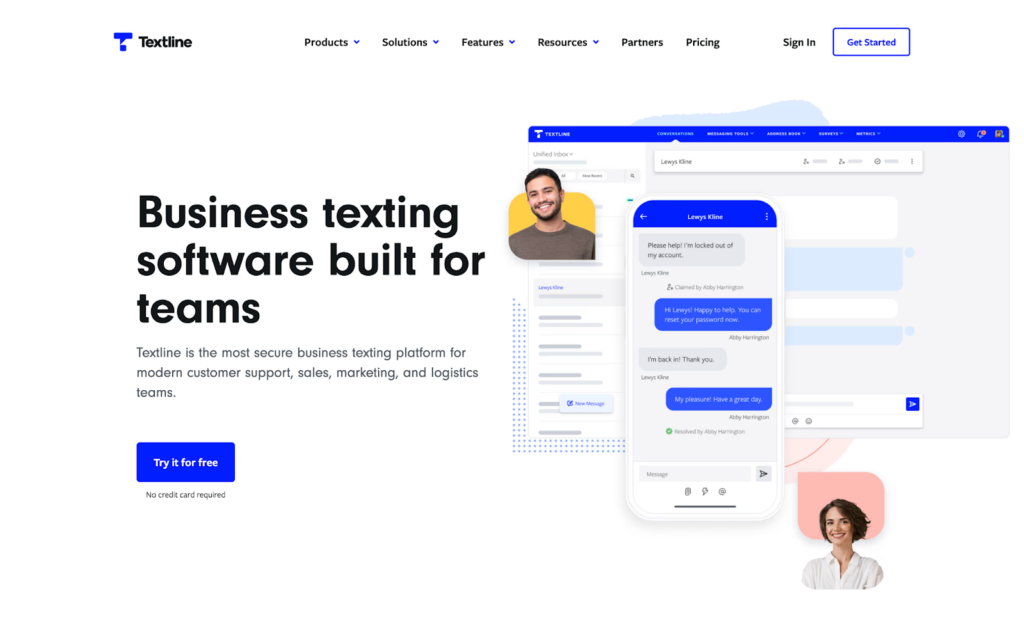
Textline stands out as the first truly HIPAA-compliant business texting platform, specifically built for regulated industries like healthcare. With its patented consent process and enterprise-grade security, it addresses the core compliance challenges that plague healthcare organizations.
Textline vs. Traditional Healthcare Communication: Key Differences
| Compliance Feature | Textline | Traditional Methods |
| HIPAA Consent Process | Patented workflow with audit-ready proof | Manual consent tracking prone to errors |
| Data Security | SOC 2 Type II certified with encryption | Varies by vendor, often inadequate |
| Access Controls | Granular role-based permissions with MFA | Basic user accounts with weak authentication |
| Audit Trails | Comprehensive logging with timestamp records | Limited or incomplete documentation |
| PHI Protection | Automatic redaction and customizable retention | Manual processes with high error risk |
| Integration Capability | Native EHR/EMR integrations with API access | Disconnected systems requiring manual data entry |
| Team Collaboration | Shared inboxes with internal whispers | Fragmented communication across platforms |
| Compliance Support | Built-in TCPA, CCPA, and HIPAA workflows | Requires separate compliance management |
Key Features:
- Patented HIPAA consent workflow ensures audit-ready compliance documentation, unlike generic messaging platforms that require manual tracking
- SOC 2 Type II certification with automatic PHI redaction and customizable data retention policies for complete security control
- Unified inbox for SMS, MMS, and web chat with role-based access controls and internal whispers for seamless team collaboration
- Native EHR integrations with API access supporting custom workflows and automated patient communication triggers
- Advanced security features including MFA, SAML SSO, IP whitelisting, and automatic sign-out for comprehensive protection
“We researched, surveyed, and chatted with over a dozen text-solution companies, and Textline was the top contender. A year after using them, I am so glad we chose Textline. It’s user-friendly, easy to implement, and simple to train new employees on. It’s HIPAA compliant (which is huge for us), has great customer support, and is the perfect tool for daily use.” – Felisha W. (G2)
Pricing starts at Custom Quote
Textline offers three main plans tailored to healthcare organizations’ compliance needs:
| Plan | Features | Best For |
| Essentials | 600 message credits, multi-department support, 3-year conversation history, surveys, standard integrations, API/webhooks, HIPAA-compatible | Small practices starting their compliance journey |
| Pro | 2,000 message credits, unlimited conversation history, advanced automations, Salesforce integration, advanced security, priority support, dedicated CSM, HIPAA-compatible | Mid-size healthcare organizations |
| Enterprise | Custom messaging credits, large-scale deployment support, advanced security controls, dedicated compliance support, custom integrations, HIPAA-compatible | Large health systems and multi-location practices |
Additional message credits cost $0.03 each (1 SMS = 1 credit, 1 MMS = 3 credits), with backup credits at $0.04 each for uninterrupted service.
What else can you do with Textline?
Beyond HIPAA-compliant messaging, Textline offers comprehensive communication solutions including mass announcements for health alerts, automated appointment reminders, patient surveys for satisfaction tracking, landline texting for existing phone numbers, and Chrome extension integration for seamless workflow management. The platform’s API supports custom healthcare applications and automated workflows.
Considerations before going with Textline: While Textline excels in compliance and security, pricing isn’t publicly available and requires consultation. Organizations seeking the lowest-cost solution may find other options more budget-friendly, though they’ll sacrifice the patented compliance features and enterprise-grade security.
2) TigerConnect – Clinical Workflow Integration for Large Health Systems
G2 Rating: 4.3/5 (200+ reviews)
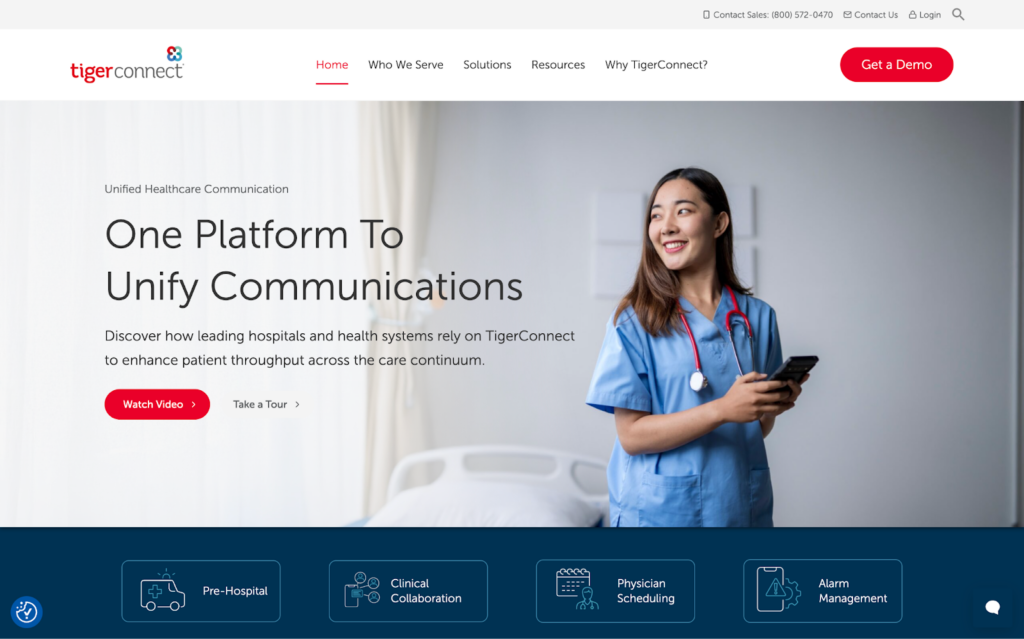
TigerConnect is a leading clinical communication platform trusted by thousands of healthcare organizations. It unifies messaging, alerts, scheduling, and video into one secure, cloud-native platform designed specifically for clinical workflows.
Key Features:
- Role-based messaging system contacts clinicians by role rather than name, streamlining urgent communications and reducing response delays
- CareConduit integration engine normalizes data from EHRs, nurse call systems, and medical devices with intelligent routing workflows
- FDA-cleared alarm management connects to patient monitors and medical devices, routing only actionable alerts to reduce alarm fatigue
- HITRUST certification with 99.995% uptime and enterprise-grade security controls including end-to-end encryption and admin controls
- Pre-hospital integration links EMS crews with hospital teams for faster patient handoffs and improved door-to-treatment times
Pricing starts at Custom Quote
TigerConnect offers enterprise pricing based on organization size and deployment needs. The platform is designed for large health systems requiring extensive integration and administrative control.
Considerations before going with TigerConnect: Best suited for large healthcare organizations with complex clinical workflows. Smaller practices may find the platform over-engineered for their needs, and the enterprise focus means higher costs and longer implementation timelines.
3) OhMD – Patient Texting with Comprehensive EHR Integration
G2 Rating: 4.6/5 (1000+ reviews)
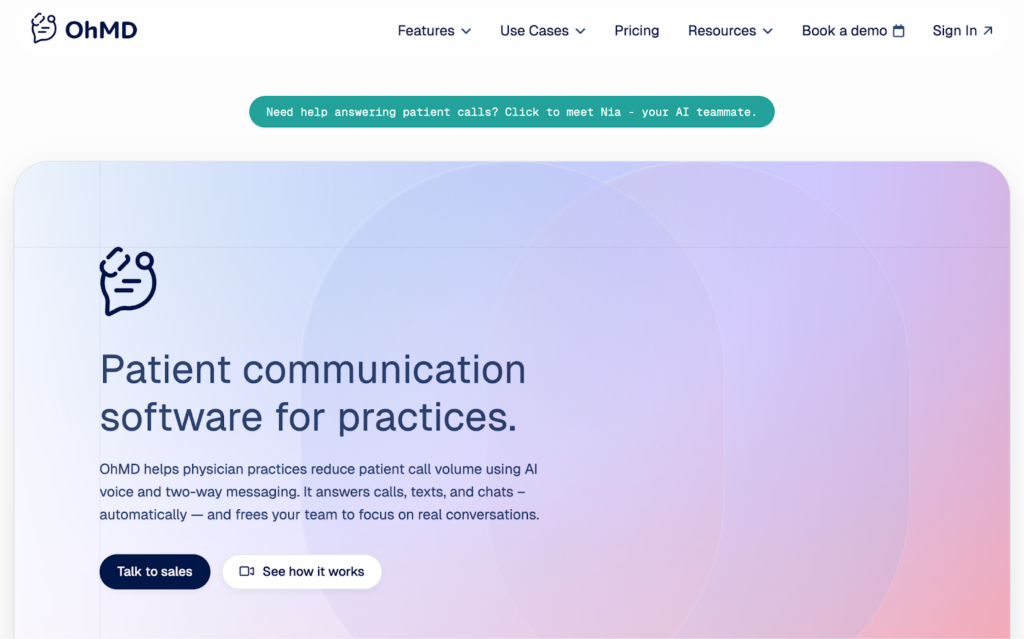
OhMD is a HIPAA-compliant patient communication platform that centralizes messaging, call-to-text, voicemail transcription, and video visits into one workflow. It integrates with over 85 EHR and practice management systems.
Key Features:
- Text-enable existing phone numbers allowing patients to use familiar contact methods without downloading apps or creating accounts
- 85+ EHR integrations including Epic, Cerner, athenahealth, and AdvancedMD with one-click conversation export to patient records
- Call-to-text with voicemail transcription dramatically reduces phone volume while maintaining patient accessibility and staff efficiency
- Automated workflows for appointment reminders, prescription refills, and follow-ups with smart routing based on keywords and triggers
- Referral management system captures referral details directly into EHR, eliminating leakage and ensuring patient opportunities aren’t lost
Pricing starts at $250/month
OhMD offers transparent pricing starting at $250 monthly for basic patient communication features, with custom pricing for larger organizations and advanced integrations.
Considerations before going with OhMD: Primarily focused on patient communication rather than internal clinical messaging. Organizations needing robust provider-to-provider communication may require additional platforms for complete coverage.
4) Klara – AI-Driven Patient Message Triage for Multi-Department Teams
G2 Rating: 4.4/5 (300+ reviews)
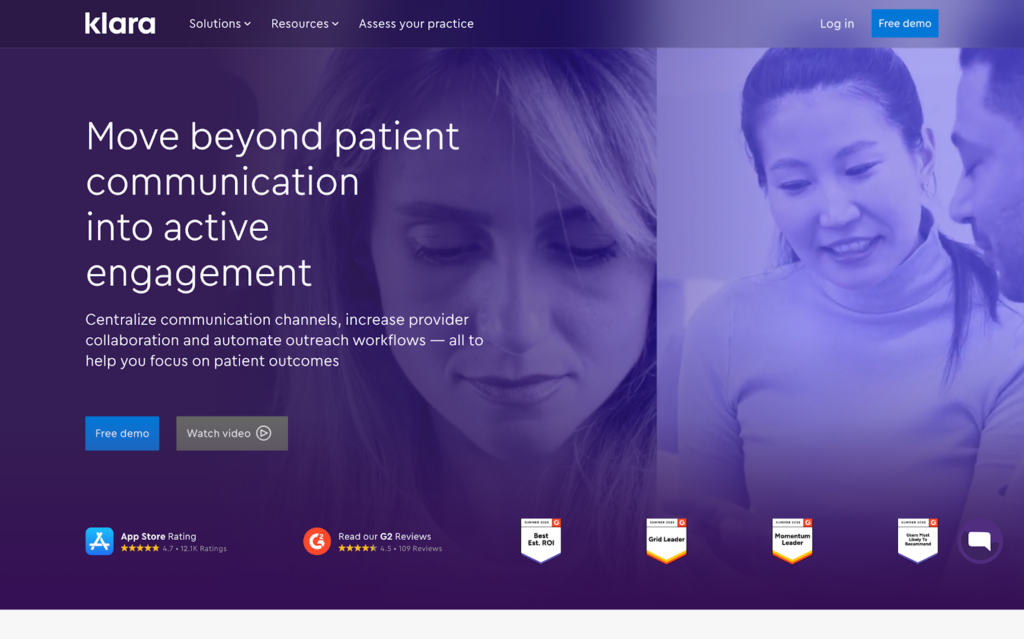
Klara is a patient communication and collaboration platform that uses AI to simplify interactions between practices, patients, and care teams through multi-channel messaging and workflow automation.
Key Features:
- AI-powered message routing automatically directs patient communications to appropriate staff members or departments based on content and context
- Multi-channel communication supports text messaging, web chat, call-to-text, and voicemail transcriptions in a unified interface
- No-login patient experience eliminates barriers to communication while maintaining HIPAA compliance through secure, encrypted messaging
- Integrated telemedicine with video visits, virtual waiting rooms, and file sharing capabilities for comprehensive remote care delivery
- EHR synchronization with major systems including AthenaHealth, Veradigm, and Nextech for seamless workflow integration
Pricing starts at Custom Quote
Klara provides custom pricing based on practice size and feature requirements, with free demos available to evaluate the platform’s AI capabilities.
Considerations before going with Klara: The AI-driven features require time to learn organizational workflows and may need adjustment periods. Smaller practices might not fully utilize the advanced routing capabilities designed for multi-department operations.
5) Spruce Health – All-in-One Telemedicine with Secure Communication
G2 Rating: 4.5/5 (150+ reviews)
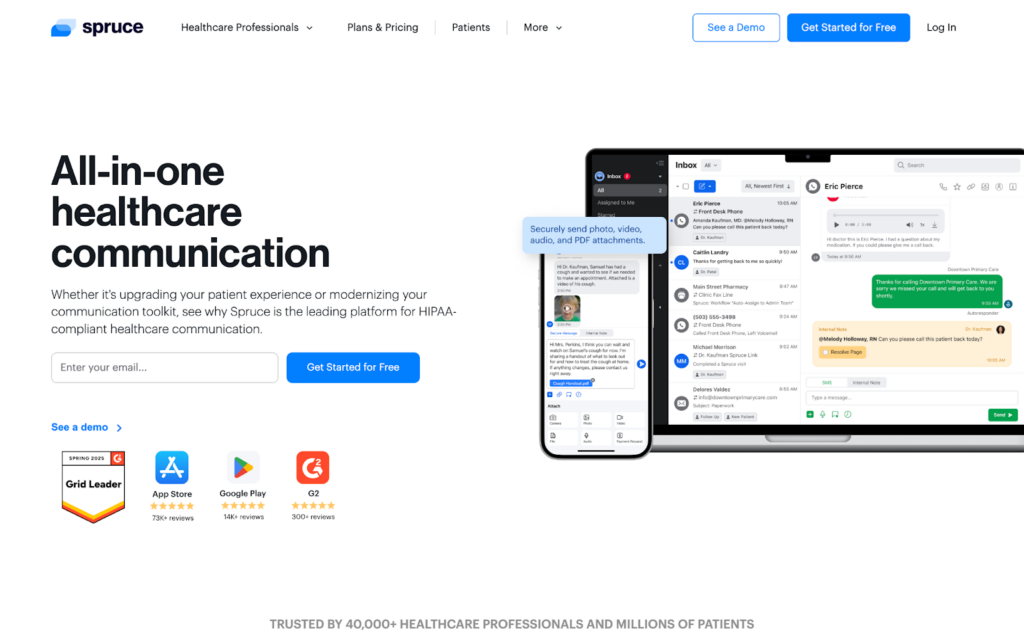
Spruce Health offers an integrated platform combining secure messaging, video visits, and automated workflows with comprehensive EHR integration for complete patient engagement.
Key Features:
- Integrated video consultations with shared inboxes and automated workflows eliminate the need for separate telemedicine platforms
- Two-way secure messaging supports both patient communication and internal team collaboration with comprehensive audit trails
- Automated appointment workflows handle scheduling, reminders, and follow-ups while maintaining HIPAA compliance throughout the process
- Shared inbox management allows multiple team members to collaborate on patient communications with internal notes and task assignment
- EHR integration capabilities sync patient data and conversation history to maintain accurate medical records
Pricing starts at $24/user/month
| Plan | Price | Features |
| Basic | $24/user/month | Secure messaging, basic video visits, automated workflows |
| Communicator | $49/user/month | Advanced features, enhanced integrations, priority support |
Spruce Health offers a 14-day free trial to evaluate platform capabilities before committing to a paid plan.
Considerations before going with Spruce Health: While comprehensive, the platform may be complex for practices only needing basic messaging capabilities. The per-user pricing model can become expensive for larger teams compared to flat-rate alternatives.
6) Paubox – Seamless HIPAA-Compliant Email Encryption
G2 Rating: 4.2/5 (100+ reviews)
Paubox focuses specifically on HIPAA-compliant email and text communications, providing seamless encryption that works with existing email platforms without requiring recipient portals or passwords.
Key Features:
- Seamless email encryption works with existing email platforms like Gmail and Outlook without requiring recipient portals or special software
- Built-in security features include phishing protection, malware filtering, and data loss prevention with real-time threat monitoring
- Secure text messaging complements email encryption with HIPAA-compliant SMS capabilities for urgent patient communications
- Analytics and reporting provide detailed insights into email delivery, engagement, and security metrics for compliance documentation
- Business Associate Agreement included with all plans to ensure proper HIPAA compliance coverage for healthcare organizations
Pricing starts at $38/month
| Plan | Price | Features |
| Email Suite | $38/month | Up to 5 users, email encryption, basic security features |
| Custom Plans | Contact for pricing | Larger organizations, advanced features, dedicated support |
Considerations before going with Paubox: Primarily focused on email encryption rather than comprehensive communication platforms. Organizations needing robust messaging, video, or advanced workflow features will require additional solutions.
7) SimplePractice – Integrated Practice Management with Secure Messaging
G2 Rating: 4.6/5 (2000+ reviews)
SimplePractice combines secure portal messaging with integrated telehealth, billing, and documentation in a single platform designed for solo providers and small practices.
Key Features:
- Integrated practice management combines secure messaging with scheduling, billing, documentation, and telehealth in one comprehensive platform
- Portal-based patient communication provides secure messaging through a dedicated patient portal with appointment scheduling and document sharing
- In-session chat capabilities during video visits enable real-time communication and file sharing for enhanced patient care
- Automated appointment workflows handle scheduling confirmations, reminders, and follow-ups while maintaining HIPAA compliance
- Comprehensive audit trails document all patient communications and system access for compliance reporting and security monitoring
Pricing starts at $49/month
SimplePractice offers straightforward pricing starting at $49 monthly for solo practitioners, with scalable plans for growing practices.
Considerations before going with SimplePractice: Designed primarily for mental health and wellness practices. Medical practices requiring complex clinical workflows or extensive EHR integrations may need more specialized solutions.
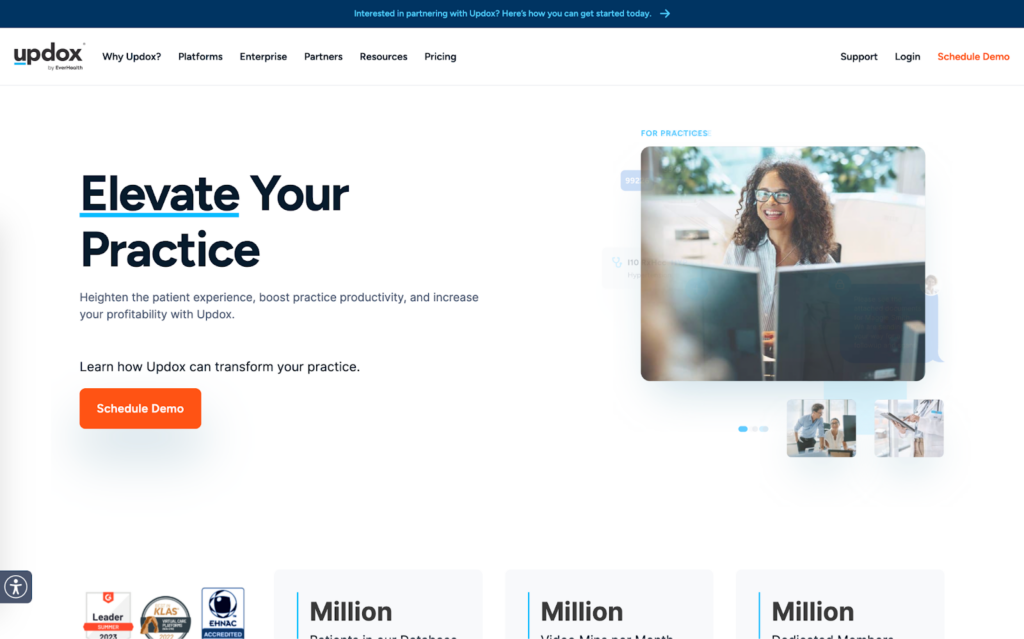
8) Updox – Unified Communication Inbox for Multi-Location Practices
G2 Rating: 4.1/5 (250+ reviews)
Updox centralizes fax, email, and video communications into a unified inbox with Direct Secure Messaging and comprehensive audit trails designed for multi-location healthcare practices.
Key Features:
- Unified communication inbox consolidates fax, email, secure messaging, and video calls into a single interface for streamlined workflow management
- Direct Secure Messaging provides HIPAA-compliant provider-to-provider communication with comprehensive audit trails and delivery confirmation
- Multi-location support enables centralized communication management across multiple practice locations with role-based access controls
- Document handling capabilities support secure fax transmission, file sharing, and document management with encryption and audit logging
- Integration with practice management systems streamlines workflows and maintains accurate patient communication records
Pricing starts at Custom Quote
Updox provides custom pricing based on practice size, number of locations, and feature requirements.
Considerations before going with Updox: Best suited for established practices with multiple locations. Solo practitioners or single-location practices may find the platform more complex and expensive than necessary for their communication needs.
9) OnPage – Critical Alerting with Persistent Notifications
G2 Rating: 4.0/5 (75+ reviews)
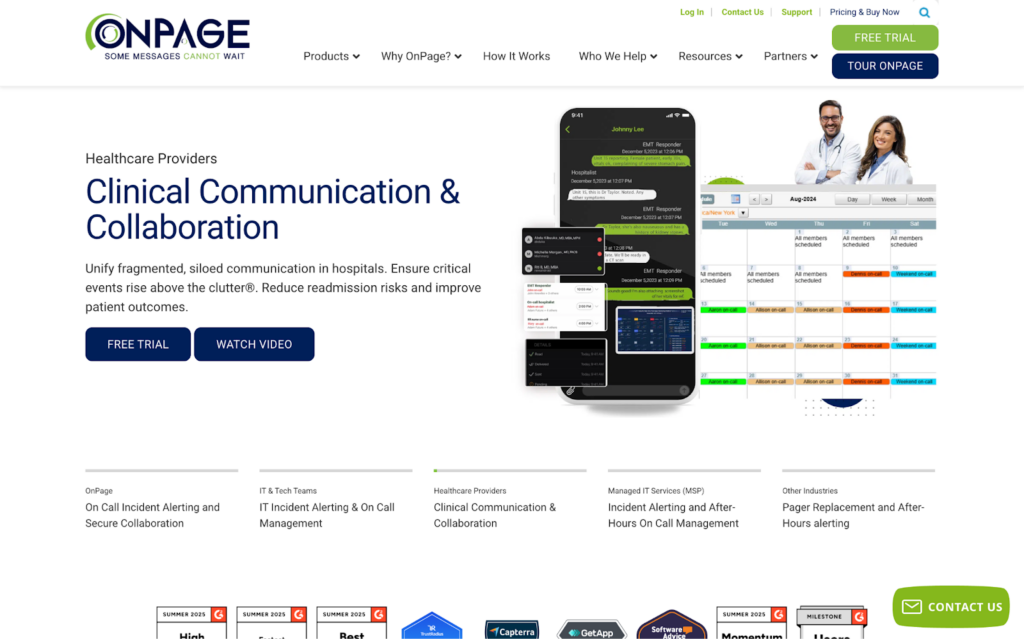
OnPage provides HIPAA-secure messaging with persistent “alert-until-read” notifications, intelligent on-call scheduling, and seamless integrations designed for organizations requiring critical alerting capabilities.
Key Features:
- Persistent alert notifications ensure critical messages are acknowledged with “alert-until-read” functionality and multi-level escalation workflows
- Intelligent on-call scheduling with automated escalation ensures the right person receives urgent communications based on availability and role
- Comprehensive audit trails document all communications, acknowledgments, and escalations for compliance reporting and incident analysis
- EHR and nurse call integrations via robust API enable automated alerting based on patient conditions and clinical system events
- Remote device management includes remote wipe capabilities and mobile device management for enhanced security control
Pricing starts at $13.99/user/month
OnPage offers competitive per-user pricing starting at $13.99 monthly, making it accessible for organizations of various sizes.
Considerations before going with OnPage: Primarily focused on critical alerting rather than general patient communication. Practices needing comprehensive patient engagement features will require additional platforms for complete coverage.
10) Spok – Legacy System Transition for Pager-to-Digital Migration
G2 Rating: 3.9/5 (50+ reviews)
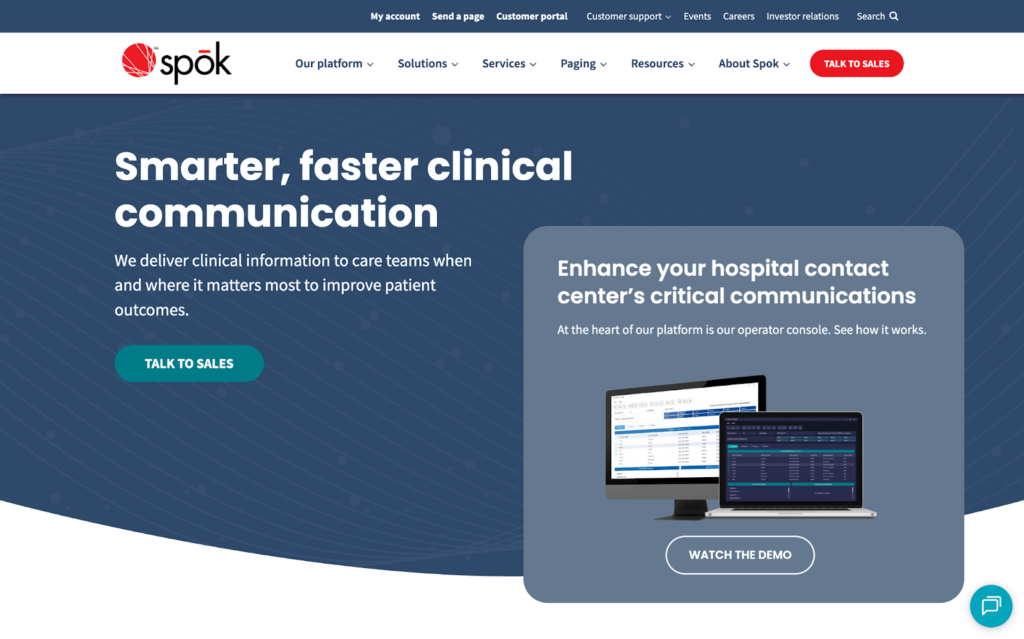
Spok provides HIPAA-compliant secure messaging with audit logs and clinical alerting specifically designed for hospitals transitioning from traditional paging systems to modern digital communication.
Key Features:
- Legacy system integration seamlessly transitions organizations from traditional pagers and switchboards to modern digital messaging platforms
- Clinical alerting capabilities tie into existing nurse call systems and clinical workflows with role-based message routing
- Comprehensive audit logging documents all communications and system interactions for compliance reporting and security monitoring
- Role-based messaging ensures communications reach appropriate clinical staff based on department, specialty, and on-call status
- Device management features support both traditional paging devices and modern smartphones for flexible deployment options
Pricing starts at Custom Quote
Spok provides quote-based pricing tailored to organization size and migration complexity from legacy systems.
Considerations before going with Spok: Best suited for large hospitals with existing paging infrastructure. Modern healthcare organizations starting fresh may find more innovative solutions better suited to current communication needs.
Essential HIPAA Compliance Best Practices
Administrative Safeguards
Implement Comprehensive Risk Assessments Conduct regular, enterprise-wide risk assessments to identify vulnerabilities before they’re exploited. Update assessments annually or after significant system changes.
Establish Strong Access Controls
- Implement role-based access with minimum necessary permissions
- Require multi-factor authentication for all system access
- Regularly audit user access and promptly remove permissions for departed employees
- Maintain detailed logs of who accessed what information and when
Develop Incident Response Procedures
- Create clear protocols for identifying and responding to potential breaches
- Establish notification procedures to meet the 60-day reporting requirement
- Train staff on recognizing and reporting security incidents
- Conduct regular drills to test response procedures
Physical Safeguards
Secure Workstations and Devices
- Lock screens when unattended and implement automatic timeouts
- Use encrypted storage for all devices containing PHI
- Implement remote wipe capabilities for mobile devices
- Restrict physical access to areas containing PHI
Control Facility Access
- Limit access to areas containing PHI to authorized personnel only
- Implement visitor logs and escort procedures
- Secure disposal of PHI through certified shredding services
- Monitor and log physical access to sensitive areas
Technical Safeguards
Encrypt All PHI
- Use end-to-end encryption for all electronic communications
- Encrypt data both in transit and at rest
- Implement secure key management procedures
- Regularly update encryption standards to current best practices
Implement Audit Controls
- Log all system access and PHI interactions
- Monitor for unusual access patterns or potential breaches
- Regularly review audit logs for compliance violations
- Maintain logs for the required retention period
Ensure Data Integrity
- Implement backup and recovery procedures
- Test backup systems regularly to ensure data can be restored
- Use version control for electronic documents
- Protect against unauthorized alteration of PHI
Staff Training and Awareness
Conduct Regular HIPAA Training
- Provide initial HIPAA training for all new employees
- Conduct annual refresher training for existing staff
- Document all training completion for compliance records
- Update training materials to reflect current threats and procedures
Establish Clear Policies
- Create written policies for all HIPAA requirements
- Ensure policies are easily accessible to all staff
- Regularly update policies to reflect changes in regulations or technology
- Require acknowledgment of policy understanding from all employees
Choosing the Right HIPAA Compliance Solution
For Small Practices (1-10 providers)
Consider solutions like SimplePractice or OhMD that offer integrated practice management with straightforward pricing and minimal complexity. These platforms provide essential HIPAA compliance features without overwhelming smaller teams.
For Mid-Size Organizations (10-50 providers)
Textline or Klara offer the right balance of advanced features and scalability. Their compliance-first design and team collaboration tools support growing organizations while maintaining security standards.
For Large Health Systems (50+ providers)
TigerConnect or Textline Enterprise provide the robust integration capabilities and administrative controls needed for complex healthcare environments with multiple locations and departments.
For Specialized Needs
- Email-focused practices: Paubox for seamless encryption
- Critical alerting requirements: OnPage for persistent notifications
- Legacy system migration: Spok for pager-to-digital transitions
- Project management focus: ClickUp for comprehensive workspace needs
The Verdict: Which HIPAA Compliance Solution Should You Choose?
After evaluating platforms across security, compliance, usability, and value, here are our top recommendations:
• Textline emerges as the clear leader for healthcare organizations serious about compliance. Its patented HIPAA consent process, SOC 2 Type II certification, and compliance-first design provide unmatched security for regulated industries. The platform’s team collaboration features and comprehensive integration capabilities make it ideal for organizations prioritizing both compliance and operational efficiency.
• OhMD offers excellent value for small-to-mid size practices focused on patient communication. With transparent pricing starting at $250/month and integration with 85+ EHR systems, it provides essential HIPAA compliance features without complexity. The platform’s patient-friendly approach and comprehensive automation make it perfect for practices wanting to improve patient engagement while maintaining security.
• TigerConnect stands out for large health systems requiring extensive clinical workflow integration. Its role-based messaging, FDA-cleared alarm management, and 99.995% uptime make it the top choice for complex healthcare environments where clinical communication directly impacts patient outcomes.
The key to successful HIPAA compliance isn’t just choosing the right tool, it’s implementing comprehensive policies, training staff properly, and maintaining vigilant oversight of all patient data interactions. Start with a thorough risk assessment, select a platform that matches your organization’s size and needs, and remember that compliance is an ongoing process requiring continuous attention and improvement.

ZoomInfo Pricing Plans? How Much Does ZoomInfo Cost?

Why Your Traffic Stopped Growing and How an SEO Expert Diagnoses It

Why Your Outreach Fails Without Accurate Hospital & Physician Data

Why Data Accuracy Matters in Legal Cases Against Negligent Nursing Homes

Why Compliance Is Critical in Healthcare Marketing

Why Booking Automation Should Be Part of Every Small Business Lead Funnel