
Last updated on August 6th, 2026
Healthcare organizations face increasing pressure to deliver fast, accurate, and accessible support across every patient touchpoint. From appointment scheduling and billing inquiries to prescription refills and follow-ups, patient communication is growing in both volume and complexity. At the same time, hospitals, clinics, and telehealth providers must meet strict compliance requirements while operating with limited administrative resources.
Traditional call centers and manual workflows are no longer sufficient. AI-powered customer support solutions are transforming healthcare communication by automating routine inquiries, providing 24/7 assistance, intelligently routing conversations, and supporting staff with real-time recommendations. Rather than replacing human teams, AI helps reduce administrative burden so healthcare professionals can focus on delivering quality care.
In this article, we explore seven AI-powered customer support solutions that help healthcare organizations improve patient experience and scale efficiently in a digital-first environment.
1. Crisp
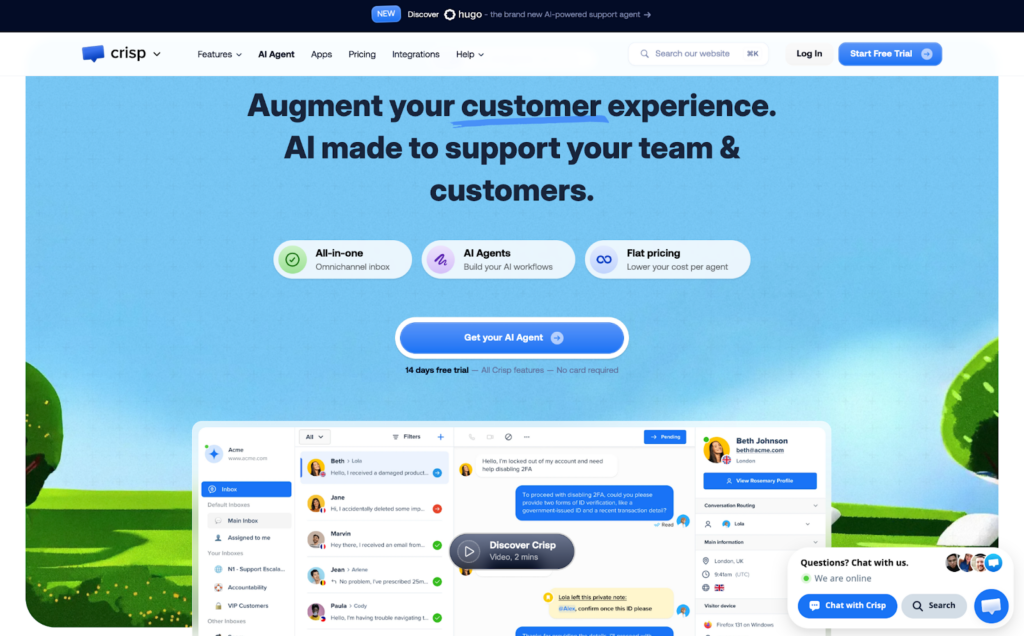
Crisp is an AI-powered, omnichannel customer support platform that centralizes conversations, automates workflows, and enhances team productivity. As an all-in-one suite, it combines a shared inbox, AI agents like Hugo, workflow automation software and tools, a knowledge base, CRM features, and analytics into a single platform, enabling organizations to manage conversations across multiple channels efficiently. Crisp AI is trained using Knowledge Base articles, website content through automated crawling, conversation history, Answers Snippets (Q&A format), and uploaded files such as PDFs and CSVs.
For healthcare organizations handling sensitive patient communications, maintaining structured workflows and strong oversight is essential, especially when operating in environments governed by regulations such as HIPAA. Crisp’s centralized inbox, controlled AI confidence settings, and knowledge-based training approach can support organizations seeking greater consistency and visibility across patient interactions.
In addition to customer-facing AI agents, the platform also includes an internal AI copilot that suggests replies, summarizes conversations, and uses ongoing context to improve response quality. This makes it a powerful solution among AI agents for businesses, offering enhanced efficiency and smarter decision-making. It also features adjustable confidence controls for more reliable AI interactions.
Key AI Features for Healthcare
- AI Agent (Hugo) to resolve inquiries faster and automate repetitive questions
- Multi-source AI training, including Knowledge Base articles, website content (via crawler), conversation history, and uploaded files (PDFs, CSVs)
- Answers Snippets (Q&A format) to continuously refine and improve AI responses
- Internal AI Copilot that suggests replies, summarizes conversations, and uses real-time context
- Confidence controls (MagicReply bot block) to reduce uncertain or low-quality answers
- Drag-and-drop workflow builder for automated conversational flows
- Omnichannel shared inbox (Chat, Email, WhatsApp, Messenger + additional channels)
- Built-in analytics and flat pricing, with AI included and no per-conversation fees
Pricing
Plans start with a Free tier ($0/month) for small teams, followed by Mini ($45/month), Essentials ($95/month), and Plus ($295/month), each adding more seats, AI credits, automation, and advanced features. A custom Enterprise plan is also available for larger organizations.
2. Zendesk AI
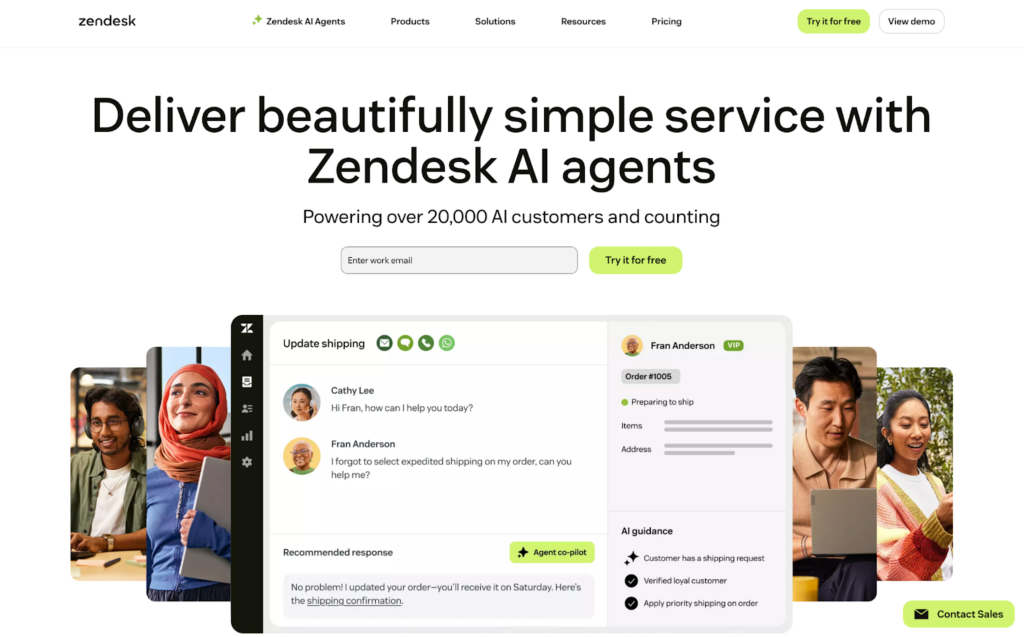
Zendesk AI is the artificial intelligence layer integrated into the Zendesk customer service platform, designed to help support teams improve efficiency and accelerate response times. Built on top of Zendesk’s core ticketing and support infrastructure, Zendesk AI uses machine learning to assist with tasks such as automated responses, intent classification, and suggested replies, while still allowing human agents to take over when needed. It is part of Zendesk’s broader suite of support tools, which includes ticketing, knowledge management, chat, and analytics, and is aimed at helping organizations streamline customer service workflows and improve customer experience.
Key AI Features for Healthcare
- AI-assisted responses to common questions, reducing manual work
- Suggested replies for support agents to handle inquiries faster
- Intent detection and ticket categorization to route conversations efficiently
- Knowledge capture and reuse to improve support consistency
- Integration with Zendesk Support tools for seamless workflows
- Context-aware insights based on ticket history and conversation context
Pricing
Zendesk plans start at $19 per agent/month (billed annually), with AI-enabled Suite plans beginning at $55 per agent/month and scaling to $169 per agent/month for Enterprise. Advanced AI features and add-ons like Copilot are available at additional cost.
3. Freshdesk (Freddy AI)
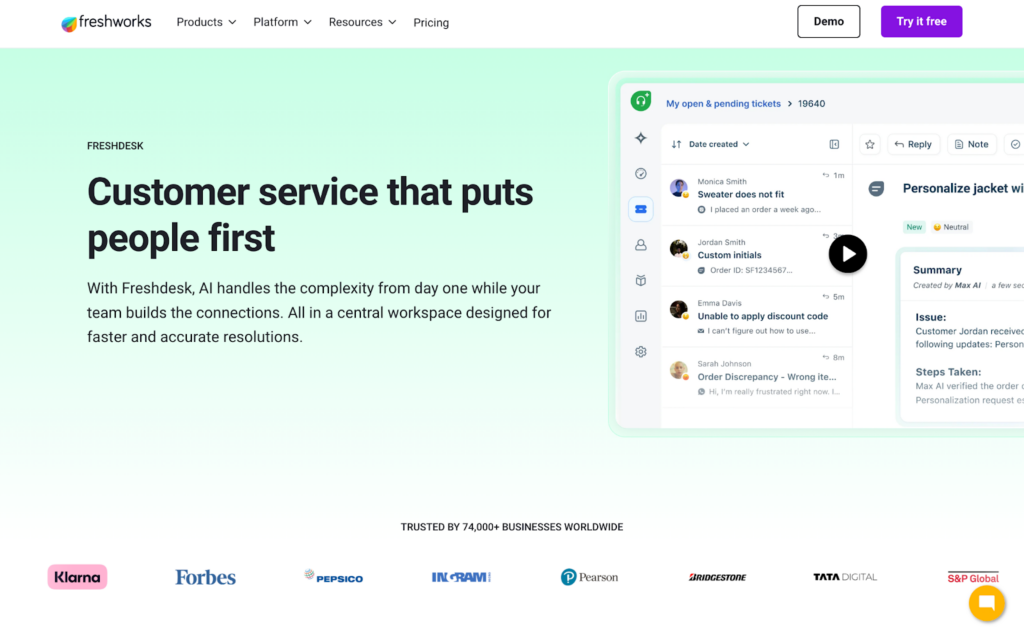
Freshdesk, part of the Freshworks customer support suite, is a cloud-based platform that consolidates omnichannel ticketing, chat, email, and automation into one unified helpdesk. Its built-in AI capabilities are powered by Freddy AI, which enhances both self-service and agent productivity through automated responses, ticket summarization, suggested replies, sentiment analysis, and proactive support insights across support channels.
Key AI Features for Healthcare
- Freddy AI Agent to automate common patient inquiries and provide 24/7 responses
- Freddy AI Copilot for agents, offering reply suggestions, ticket summarization, tone enhancements, and writing assistance
- Automated ticket triage and prioritization based on intent and sentiment
- Suggested solution articles from the knowledge base to deflect repetitive questions
- Sentiment analysis to identify urgent or frustrated cases
- Multilingual support for diverse patient populations
- Integration with CRM and support workflows for streamlined operations
Pricing
Freshdesk plans start with a Free tier, followed by paid plans such as Growth (~$15 per agent/month), Pro (~$49–$59 per agent/month), and Enterprise (~$79 per agent/month), with advanced AI capabilities available in higher tiers or as optional add-ons.
4. Tidio (Lyro AI)
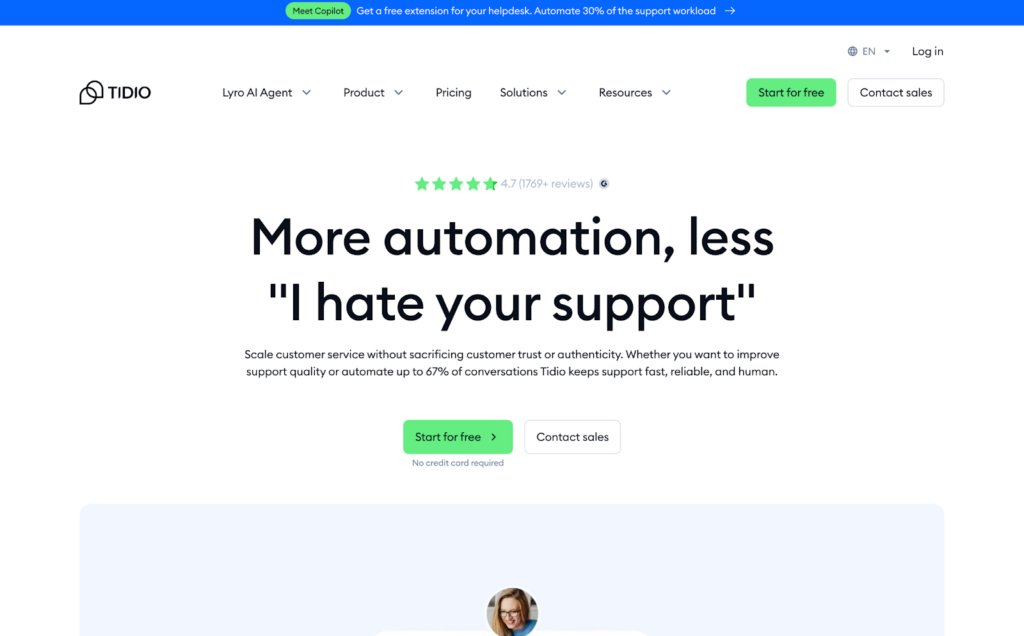
Tidio is a conversational customer support platform that combines live chat, chatbots, and AI automation to help businesses engage website visitors and resolve customer inquiries more efficiently. Its AI features are powered by Lyro AI, which adds natural language understanding and automated response capabilities directly into Tidio’s chat and chatbot workflows. Designed for small to mid-sized businesses, Tidio’s AI tools help automate common questions, provide instant replies, assist support teams with suggested responses, and deliver a personalized conversational experience across channels like website chat, email, and Messenger.
Key AI Features for Healthcare
- Lyro AI chatbot to automate responses to frequent patient questions and reduce manual workload
- AI-powered instant replies to common inquiries like appointment details, hours, and FAQs
- Suggested replies for agents to speed up manual responses
- Intent recognition to understand user queries and deliver relevant answers
- Custom chatbot workflows to guide patients through specific tasks (e.g., appointment booking guidance)
- Multichannel support including live chat, email triggers, and Messenger integration
- Basic analytics to track chat performance and engagement trends
Pricing
Tidio offers a Free plan ($0/month) with limited conversations and basic features. Paid plans start with Starter ($24.17/month), followed by Growth (starting at $49.17/month) and Plus (starting at $749/month), with higher tiers adding more automation, analytics, and customization features. Lyro AI Agent is also available as a standalone add-on, starting at $32.50/month with usage-based conversation limits. Custom Premium pricing is available for larger organizations.
5. LivePerson
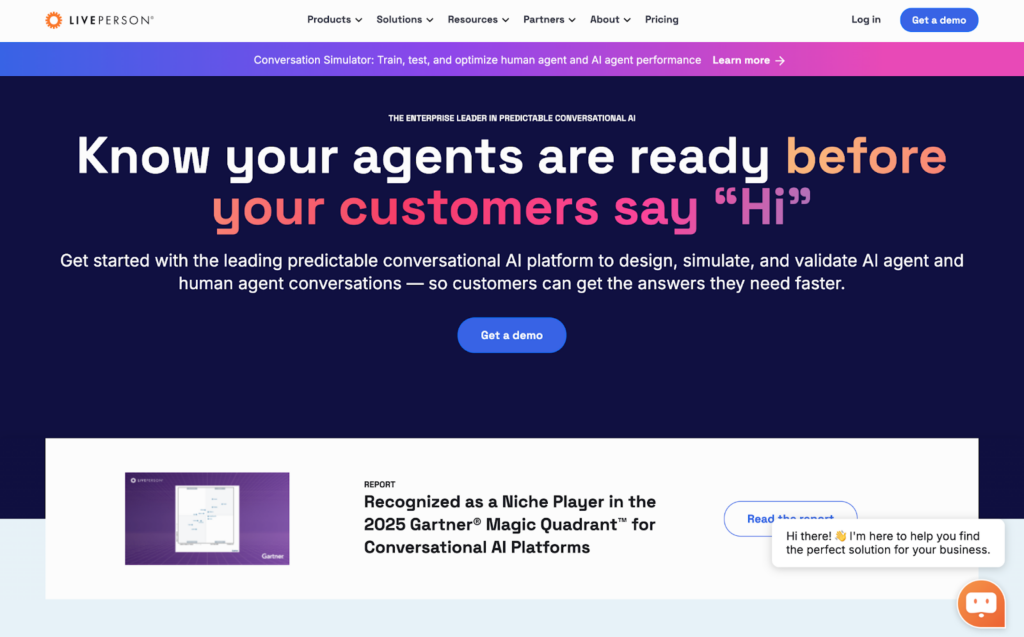
LivePerson is a conversational AI and customer engagement platform designed to help organizations automate and scale customer interactions across digital channels like web chat, mobile apps, social messaging, and SMS. Its Conversational Cloud combines AI-powered chatbots, routing, agent workspace tools, analytics, and real-time messaging to enable intelligent customer support at scale. LivePerson’s AI tools can automate routine inquiries, interpret user intent, refine messaging, and integrate with existing systems and knowledge bases to support both automated and human-assisted workflows.
Key AI Features for Healthcare
- AI-powered chatbots that automate responses to common patient questions
- Intent recognition and routing to direct complex cases to human agents
- AI Copilot and generative capabilities to assist agents with message refinement and contextual replies
- Natural language understanding to interpret diverse patient inquiries
- Multichannel support across messaging platforms, web, and mobile
- Advanced analytics and insights to monitor performance and interaction trends
- Customizable prompts and AI behavior to align conversations with brand tone and operational goals
Pricing
LivePerson offers tiered plans including Bronze, Silver, and Gold, with features expanding from agent messaging tools to advanced automation, analytics, and Generative AI capabilities. Pricing is customized and not publicly listed, with costs determined based on usage, AI features, and business requirements. Organizations must contact sales for a tailored quote.
6. Ada
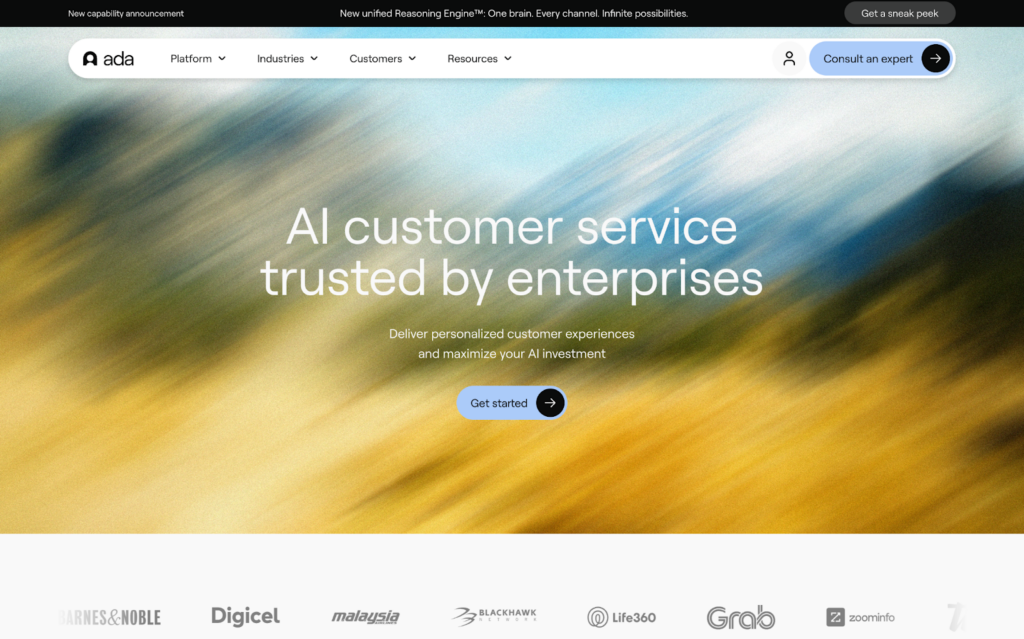
Ada is an enterprise-grade AI customer support platform that uses generative AI agents to automate and scale customer service interactions across web chat, messaging, email, voice, and other channels. Designed for omnichannel support at scale, Ada’s platform helps teams reduce manual workload, improve resolution rates, and deliver consistent, personalized experiences across languages and regions. Its AI agents are built to resolve a large portion of inquiries autonomously while maintaining context and accuracy.
Key AI Features for Healthcare
- Generative AI agents that handle routine patient inquiries and support questions across channels
- Natural language understanding (NLP) to interpret intent and context from diverse patient inputs
- Omnichannel support including web chat, messaging, email, and voice automation
- Multilingual support enabling interactions in 50+ languages for global patient communities
- Customizable dialogue flows and playbooks that reflect healthcare workflows and SOPs
- Analytics and performance tracking to monitor resolution rates, satisfaction, and trends
- API integrations and flexible deployment to work with existing CRM or support systems
- Enterprise-grade security and compliance with industry standards (e.g., HIPAA, SOC2, GDPR) for sensitive environments
Pricing
Ada does not publish standard pricing; plans are customized based on business size, usage, and feature requirements. Starting engagements typically require contacting sales for a tailored quote, with reported enterprise-level pricing often beginning around $60,000 per year for basic AI service deployments.
7. NoForm AI healthcare
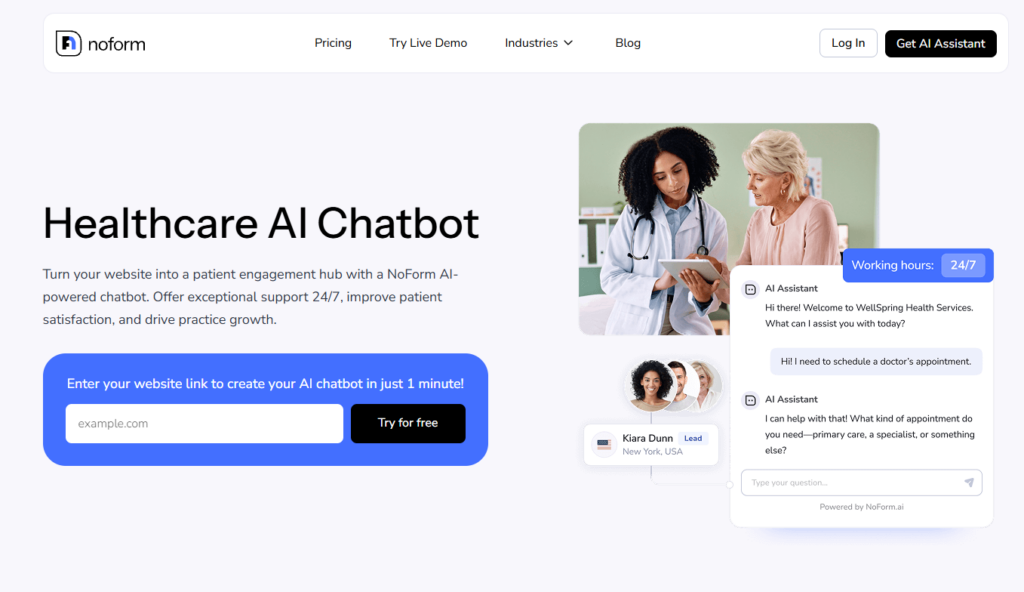
NoForm AI is an AI-powered sales assistant built for healthcare providers that want to turn more website visitors into booked patients. Instead of relying on static “Request an Appointment” forms, it engages visitors instantly in real-time conversations, answering complex questions about services, procedures, insurance, and availability.
The AI assistant naturally captures contact details during the chat. Your front desk team receives pre-qualified leads, complete with AI-generated conversation summaries, 24/7.
It automatically trains on your existing website content and installs in minutes using a simple embed code or WordPress plugin. No developers, chatbot scripting, or manual flow-building required.
Key Features
- 24/7 AI-powered lead qualification & qualification
- No-code setup and customization
- Page-specific targeting and behavior
- Multilingual support for global audiences
- Analytics and conversation insights
Final Thoughts
AI-powered customer support is no longer optional for healthcare organizations navigating rising patient expectations and operational complexity. From AI agents that automate routine inquiries to intelligent routing and real-time agent assistance, these platforms help reduce administrative burden while improving patient experiences.
The right solution depends on your organization’s size, budget, compliance requirements, and workflow complexity. By evaluating your support volume and operational needs, healthcare providers can choose an AI platform that enhances efficiency without compromising care quality.

Ampliz is a leading healthcare data intelligence platform that helps B2B marketers, sales teams, and growth leaders connect with the right healthcare decision-makers using accurate, compliant, and actionable data. With deep coverage across hospitals, physician groups, clinics, payers, and life sciences organizations, Ampliz enables precision targeting at scale.

Healthcare OEM Data in the US: How to Find Verified Medical Device Manufacturers & Decision-Makers
Last updated on October 7th, 2026 The healthcare industry in the United States is one
The Role and Benefits of Nearshore Call Centers in Healthcare Data, CRM and Patient Engagement
Last updated on July 28th, 2026 Healthcare organizations are expanding operational capacity through external support
How Healthcare Businesses Can Stay HIPAA Compliant: A Top Tools and Best Practices
Last updated on October 20th, 2026 How Healthcare Businesses Can Stay HIPAA Compliant: A Complete

The Future of Digital Health: Emerging Trends Shaping 2026 and Beyond
Last updated on October 7th, 2026 Over the past decade, the digital health landscape has
Building a Future-Ready Healthcare Team with the Right Tools
Last updated on October 6th, 2026 You are probably already planning for the future: more

B2B Healthcare Prospecting: How to Build a Qualified Lead List in Minutes
Last updated on October 7th, 2026 In the world of healthcare B2B sales, the speed