
Healthcare technology companies are solving increasingly complex problems across clinical workflows, healthcare data, automation, AI, and digital health. But having a sophisticated product does not automatically mean buyers will understand its value.
The challenge is often healthcare technology messaging.
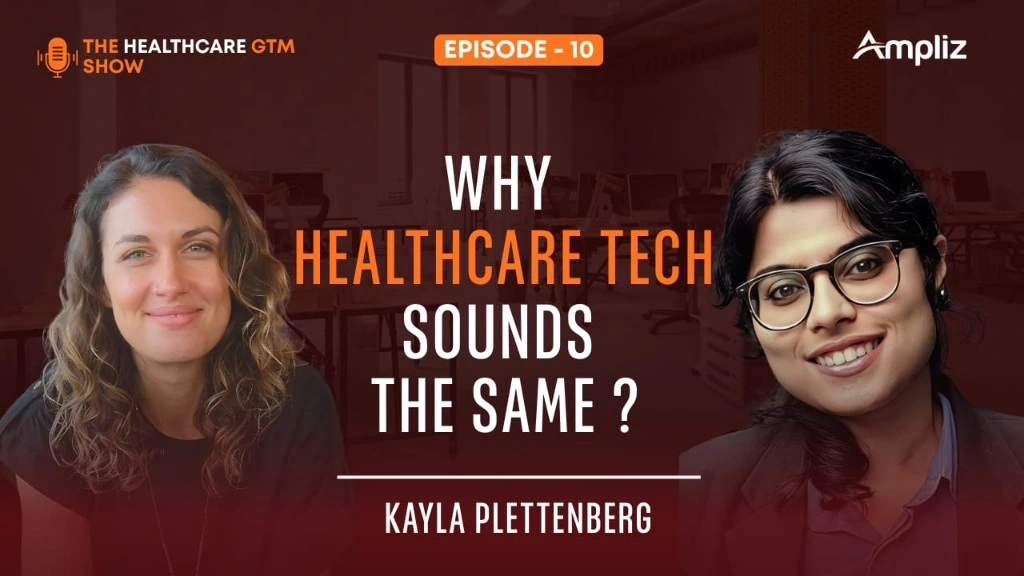
In a recent episode of The Healthcare GTM Show by Ampliz, Kayla Plettenberg, a product marketing and copywriting expert specializing in healthcare and B2B technology, shared how healthtech companies can improve product positioning, understand their buyers, build differentiation, align marketing and sales, and measure whether their messaging is actually working.
Why Healthcare Technology Messaging Often Fails
- One of the biggest problems in healthtech marketing is that companies become too focused on explaining their product.
As Kayla puts it:
“They are getting too in the weeds about the product capabilities instead of focusing on what really changes for the customer.”
Healthcare technology companies often lead with phrases such as “AI-powered platform,” “intelligent automation,” or “smarter healthcare.” While these may describe capabilities, they leave the buyer to figure out why those capabilities actually matter.
Effective healthcare messaging should therefore move from:
Features → Benefits → Customer Outcomes
The starting point should be the customer’s problem and the outcome they are trying to achieve. Features then become the proof of how the product delivers that outcome.
The goal is to make it easier for buyers to understand what changes for them, rather than making them decode what the technology does.
2. Start With the Right Healthcare Buyer
Strong healthcare product positioning starts with understanding the right buyer.
Healthcare technology buying decisions rarely involve just one person. Clinical, operational, IT, finance, procurement, and executive stakeholders can all influence a purchase. But there is usually a champion the person researching solutions, comparing vendors, and helping create the shortlist.
Kayla explains:
“You need to figure out who cares most about the value that you’re actually creating.”
That means identifying the right Ideal Customer Profile (ICP) and understanding the problems that matter most to that buyer.The champion should be able to understand your core value proposition quickly. But they also need information that helps them navigate the rest of the healthcare buying committee.
An IT leader may want to understand integrations and implementation. A CFO may focus on ROI. An operations leader may care about workflow and adoption.
The answer isn’t to create completely different stories for everyone. It is to build one core message with stakeholder-specific supporting messages.
3. How to Find Genuine Differentiation in HealthTech
Healthcare technology is a crowded market. Many companies end up using the same words:
AI. Automation. Innovation. Transformation.
So how can healthtech companies find a genuinely differentiated position?
Kayla recommends starting with a competitor messaging audit.
As she explains:
“Buyers aren’t evaluating new tools in a vacuum. They’ve got five other tabs open, comparing your website with competitors.”
Look at competitor websites and identify their primary value propositions, core benefits, repeated messaging, and the problems they claim to solve. Then look beyond competitor websites.
Customer reviews, forums, Reddit discussions, and customer interviews can reveal where competitors are falling short. They can show the difference between what a company promises and what customers actually experience.
That gap can become an opportunity for differentiation. Customer research can also reveal what buyers were using before, why it failed, what made them switch, and what they hoped to achieve.
As Kayla explains:
“You can understand a clear before versus after picture in your customers’ day-to-day life.”
That “before versus after” story can be far more powerful than another list of product features.
4. Don’t Confuse Features With Differentiation
More features do not automatically create a more differentiated product. When companies try to communicate every capability their product offers, the central narrative can disappear.
Kayla’s advice is straightforward:
“You need to figure out what’s the one thing that we want to own instead of trying to communicate every possible thing that you can do.”
Features still matter but they should support the larger positioning rather than become the positioning itself.
The question isn’t “What can our product do?”
It is:
“What do we want buyers to remember us for?”
5. Creating Consistent Messaging Across the GTM Journey
Once positioning is established, it needs to travel across the entire healthcare buyer journey. Website. Content. Email. LinkedIn. Sales decks. Demos. Outbound conversations.
This is where a strong healthcare messaging strategy and messaging framework become important.
Marketing and sales should align around the same value proposition, customer problems, benefits, and strategic narrative. But consistency does not mean repeating identical copy everywhere.
Kayla makes an important distinction:
“Messaging and copywriting are different things. So you can communicate the same core message in different ways.”
The core story remains consistent while the execution changes according to the audience, channel, buying stage, and pain point.
This is especially important because one common marketing and sales alignment problem occurs when marketing communicates customer outcomes while sales conversations revert to feature lists.
6.How to Know if Your Healthcare Messaging Is Working
Messaging shouldn’t simply be published and forgotten. It needs to be tested.
Kayla recommends gathering feedback from target buyers, speaking directly with customers, and listening to how prospects respond when sales representatives introduce the new narrative.
She also points to website and engagement signals such as:
- Website engagement
- Time on page
- Bounce rate
- Demo conversions
- Heatmap and scroll behavior
- Sales conversations
- Pipeline progression
- Customer feedback
One of the earliest signals can be surprisingly simple: Does the prospect understand the message?
From there, marketers can look at whether the message resonates, builds confidence, influences sales conversations, and ultimately contributes to pipeline movement. As more buyers use Google and AI-powered tools such as ChatGPT, Claude, and Perplexity to research B2B solutions, clear and specific content is becoming increasingly important.
This makes SEO and Answer Engine Optimization (AEO) relevant to modern healthcare marketing. Content that clearly addresses buyer questions, uses specific terminology, and demonstrates genuine expertise is easier for both search engines and AI systems to understand.
The Bottom Line
Great healthcare technology doesn’t automatically create great healthcare messaging. The strongest healthtech marketing strategies start with the buyer not the feature list.
They identify the right ICP, understand the customer’s problem, uncover genuine differentiation, create a consistent GTM narrative, and give sales the flexibility to adapt that narrative to individual conversations.
Ultimately, as Kayla’s perspective throughout the conversation demonstrates, the objective isn’t to communicate everything a product can do.
“It’s to make it immediately clear why the buyer should care.“
Hear the Full Conversation
Want to go deeper into healthcare technology messaging, product positioning, differentiation, buyer committees, and marketing and sales alignment?
Watch the full episode of The Healthcare GTM Show by Ampliz featuring Kayla Plettenberg.

Shuvasmita Nanda is a Growth Partner at Ampliz, specializing in healthcare data, healthcare marketing, and B2B go-to-market strategy. She writes research-backed articles on physician databases, hospitals, healthcare organizations, sales intelligence, and healthcare market trends. Her goal is to help healthcare businesses, marketers, and sales teams make informed decisions using accurate data and actionable insights.