

Running a business means juggling a hundred different priorities at once. And let’s be honest: keeping up with customer inquiries around the clock isn’t always realistic, especially for small teams. That’s exactly why so many companies are turning to intelligent automation to handle the heavy lifting.
The right platform can answer questions instantly, qualify leads while you sleep, and free up your team to focus on work that actually requires a human touch. But with dozens of options flooding the market, finding the perfect fit for your business can feel overwhelming.
We’ve done the legwork for you. Here’s our breakdown of the top platforms worth your attention this year, starting with our top pick.
1. Denser.ai
Best for: Businesses wanting powerful, easy-to-deploy automation
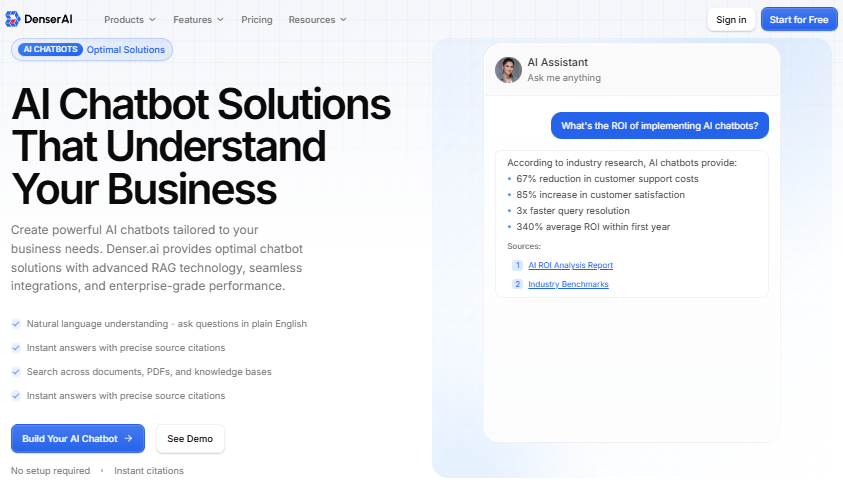
If you’re looking for a platform that combines serious capability with genuine ease of use, Denser.ai deserves the top spot on your list. This platform has quickly earned a reputation for delivering enterprise-grade performance without the enterprise-level complexity.
What sets Denser apart is its ability to learn directly from your existing content. Upload your documents, connect your knowledge base, and watch it transform into a responsive assistant that actually understands your business. No coding required. No lengthy setup process.
The platform excels at providing accurate, contextual responses that feel genuinely helpful rather than robotic. For businesses exploring AI chatbot solutions, Denser.ai offers a compelling combination of sophisticated natural language processing and straightforward implementation.
Their pricing model is refreshingly transparent, making it accessible for growing businesses while still packing enough punch for larger operations. The analytics dashboard gives you clear visibility into conversations, helping you continuously improve customer interactions.
Standout features:
- Train on your own documents and data sources
- No-code setup and customization
- Advanced semantic search capabilities
- Seamless website integration
2. Intercom
Best for: SaaS companies with complex support needs
Intercom has been a major player in the customer communication space for years, and their AI capabilities have matured significantly. Their Fin AI agent can resolve a substantial portion of support tickets without human intervention.
The platform shines when it comes to integrating support with sales and marketing workflows. If you’re already using Intercom for other purposes, adding their AI assistant creates a unified experience.
However, the pricing can climb quickly as you scale. Smaller businesses might find the cost prohibitive, especially when exploring the full feature set. The learning curve is also steeper than some alternatives.
Standout features:
- Tight integration with existing Intercom tools
- Customizable conversation flows
- Robust reporting and analytics
- Multi-channel support options
3. Drift
Best for: B2B companies focused on lead generation
Drift carved out its niche by focusing heavily on conversational marketing. Their platform is designed to capture and qualify leads through intelligent conversations that feel personal and timely.
The AI can book meetings, route prospects to the right sales reps, and nurture leads through personalized interactions. For B2B companies where every qualified lead matters, this focus on revenue generation makes Drift particularly attractive.
The downside? Drift works best when you’re fully committed to their ecosystem. The platform is less flexible for businesses that want a lighter touch or simpler implementation.
Standout features:
- Revenue-focused conversation design
- Automatic meeting scheduling
- Sales team routing and notifications
- Account-based marketing integration
4. Tidio
Best for: E-commerce businesses on a budget
Tidio offers a solid entry point for smaller businesses dipping their toes into automated customer support. The platform combines live chat with AI-powered responses in a package that won’t break the bank.
Their visual chatbot builder makes it easy to create conversation flows without technical expertise. Pre-built templates for common e-commerce scenarios (order tracking, returns, product questions) help you get up and running fast.
While Tidio handles basic use cases well, businesses with more complex needs may find themselves bumping against limitations as they grow.
Standout features:
- Affordable pricing tiers
- E-commerce platform integrations
- Visual flow builder
- Live chat and bot hybrid approach
5. Zendesk AI
Best for: Companies already invested in the Zendesk ecosystem
Zendesk has integrated AI capabilities throughout their well-established support platform. For businesses already using Zendesk for ticketing and help desk functions, their AI additions create a natural extension of existing workflows.
The platform can suggest responses to agents, automatically categorize tickets, and handle routine inquiries independently. The deep integration with Zendesk’s broader toolset is both its greatest strength and limitation.
If you’re not already a Zendesk customer, the commitment required to fully leverage their AI features might give you pause.
Standout features:
- Native integration with Zendesk Suite
- Agent assistance tools
- Intelligent ticket routing
- Knowledge base suggestions
6. Freshdesk Freddy AI
Best for: Mid-size businesses seeking balanced functionality
Freshworks has positioned Freddy AI as an accessible option for businesses wanting solid AI capabilities without overwhelming complexity. The platform handles common support scenarios competently and integrates smoothly with other Freshworks products.
Freddy can summarize tickets, suggest responses, and automate routine tasks. The pricing sits in a comfortable middle ground, making it viable for businesses that have outgrown basic tools but aren’t ready for enterprise-level investment.
The AI capabilities, while good, don’t quite match the sophistication of top-tier alternatives. Consider it a reliable workhorse rather than an innovation leader.
Standout features:
- Balanced feature set
- Reasonable pricing structure
- Multi-product integration
- Straightforward implementation
7. ChatBot.com
Best for: Businesses wanting maximum customization control
ChatBot.com takes a different approach by giving you extensive control over conversation design. Their visual builder lets you craft detailed interaction flows tailored to your specific business processes.
This flexibility appeals to businesses with unique requirements that off-the-shelf solutions don’t address well. You can build exactly what you need, assuming you’re willing to invest the time in configuration.
The trade-off is that you’ll spend more time on setup and ongoing refinement compared to platforms that handle more automatically.
Standout features:
- Highly customizable flows
- Visual conversation builder
- Testing and optimization tools
- Broad integration options
How to Choose the Right Platform for Your Business
Selecting the best option depends on several factors unique to your situation. Start by honestly assessing your technical resources. Do you have team members who can handle complex configurations, or do you need something that works out of the box?
Consider your growth trajectory as well. A platform that fits perfectly today might become limiting in a year. Look for solutions that can scale with your ambitions without requiring a complete overhaul.
Budget matters, but don’t let it be the only factor. A slightly higher investment in the right platform often pays for itself through better customer experiences and operational efficiency.
Finally, think about integration requirements. The best platform in isolation becomes problematic if it doesn’t play nicely with your existing tools.
Final Thoughts
The environment of automated customer support has evolved dramatically. Today’s platforms can handle nuanced conversations, learn from your specific business context, and deliver experiences that genuinely help customers rather than frustrate them.
For most businesses evaluating their options, Denser.ai offers the most compelling combination of power and accessibility. But every company has unique needs, and the platforms on this list each bring something valuable to the table.
The best approach? Take advantage of free trials where available. Test platforms with real scenarios from your business. Pay attention to how natural the conversations feel and how easily your team can manage the system.
Your customers expect fast, helpful responses at any hour. The right automation partner makes delivering on that expectation not just possible, but surprisingly straightforward.